
Miller's history of the semiconductor reframes the real founding myth of Silicon Valley — not software, but seventy years of fighting to put more switches on a sliver of silicon.
I came up through MIS and have spent my career on the finance side, but my picture of 'Silicon Valley' was almost entirely a software picture — the dot-com years forward. Chip War filled in the seventy years before that: the transistor, the integrated circuit, the memory and processor wars, and the boom-bust cycles that built (and broke) entire national champions. It reframed how I think about the hardware underneath every software story I know.
Full thesis
Miller's central claim is that the semiconductor — not the app, not the platform, not the algorithm — is the technology that has actually determined the shape of the global economy and the balance of geopolitical power since the Cold War. He builds that case through seven decades of boom and bust: Silicon Valley's founding out of Shockley Semiconductor and the 'Fairchildren,' the memory chip wars with Japan, the rise of the fabless model, and the current scramble over Taiwan and TSMC. It's a hardware history that explains why the software world runs on rails someone else spent fifty years and a trillion dollars laying down.
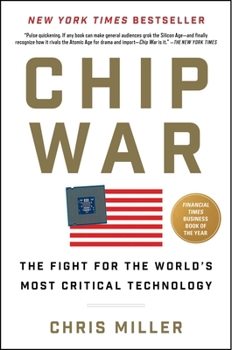
I came up through an MIS program, and tech has been the thing I follow for fun even though the day job is on the finance side — I'm a CPA working in industry now, and I lean on tech constantly to do that job well. But my mental map of "Silicon Valley" was almost entirely a software map. The dot-com years, the App Store economy, SaaS multiples, the cloud — that's the era I actually understood. I knew, in the vague way most people do, that the place got its name from something to do with chips. I didn't know the actual story, or why it mattered.
Chip War fills in the seventy years I was missing, and it's a far better story than I expected. Miller starts with the actual physical problem the pioneers were solving: how do you put more switches on a sliver of silicon, reliably, at a cost that keeps falling — and why silicon won that fight over the vacuum tubes and germanium transistors that came before it. That one engineering problem, re-solved every few years for seven decades, turns out to be the foundation everything else sits on. Shockley Semiconductor, the "Fairchildren" who scattered out of Fairchild to found Intel, AMD, and a dozen others — that lineage is the real founding myth of the Valley, a full generation before the software era I thought I knew.
What stuck with me most is how it reframes the software/hardware relationship. People on the software side — myself included — tend to treat compute as a given: it's just there, it gets faster and cheaper every year, you build on top of it and move on. Miller's book is a reminder that "faster and cheaper every year" is not a law of nature. It's the output of an industry that has to commit tens of billions of dollars to a fab, place that bet three years before a single chip ships, and get the physics right at a scale that's genuinely hard to picture. The software world I understand is downstream of a hardware world that is brutally capital-intensive, brutally cyclical, and far less forgiving of mistakes.
If you only have time to follow one thread, follow this one — it's the part of the book I'd point you to first. Miller lays the whole history out as a chain of booms that minted fortunes and busts that erased entire national champions, sometimes inside the same decade. Laid end to end, it looks less like a tech industry and more like a commodity industry that happens to run on physics instead of weather:
This book changed how I read the sector, full stop. When I look at names like TSMC, ASML, or Nvidia now, I'm not just looking at a moat — I'm looking at the output of fifty years of boom-bust scar tissue that taught a small number of companies how to survive cycles that killed everyone else around them. Capital intensity isn't a side note in this industry; it's the entire competitive structure. It's why a foundry position like TSMC's is nearly impossible to replicate from a standing start, and why memory makers like Samsung, SK Hynix, and Micron still ride pricing cycles that look nothing like the smooth, recurring-revenue stories software investors are used to underwriting.
Read it less as a tech history and more as an instruction manual for why this specific corner of the market behaves the way it does — booms that look unstoppable until they suddenly aren't, and a handful of companies that have figured out, generation after generation, how to be standing when the music stops. If you've ever wondered why semiconductor names trade the way they do, or why "this time the cycle is different" is a sentence this industry has heard — and disproven — many times before, this is the book that explains it.